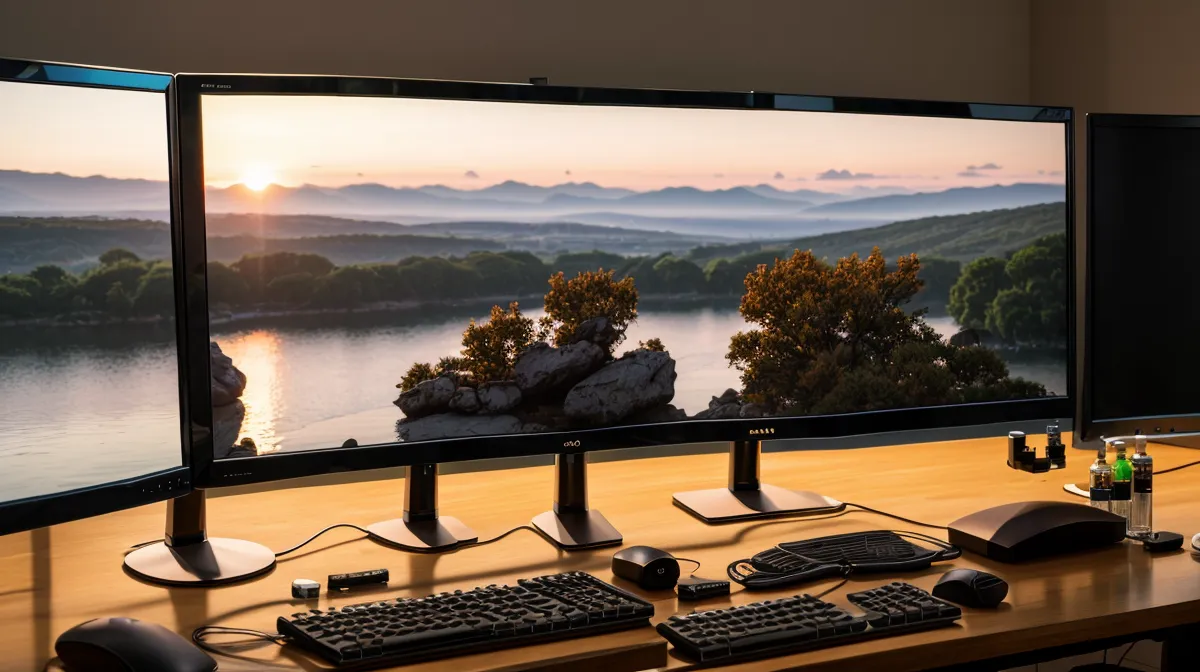
What does it actually mean when you say an eye supplement is working? Most people answer without noticing they're answering: the afternoon headache backs off, the dry grit under the eyelids eases up, so whatever they swallowed must be doing its job. I ran on that same assumption through a good chunk of my own supplement testing, treating eye health tracking as just another developer-wellness experiment — log the inputs, log how the eyes felt, look for a pattern. The thing nobody mentions is that "felt better" and "digital eye strain actually improved" are not automatically the same data point, and sorting that out took longer than I expected.
Most of what gets written about this treats comfort as the finish line: take the supplement, feel less dry, case closed. My optometrist was the one who first put a name to what was happening behind my eyes by mid-afternoon, and I went looking for a fix the way I'd look for a slow API call — find the bottleneck, patch it, move on. It took a while to notice the bottleneck and the symptom weren't actually the same thing.
The Myth That Comfort Equals Correction
The assumption goes like this: if the ache is gone, the problem is solved, and you're free to stop paying attention. That's the myth I want to pull apart here, because the log I've kept says otherwise more often than it says yes.
I have one entry in that log I keep coming back to, because for a long time it looked like proof the myth was true. It was an ordinary work block — second monitor, scrolling through a pull request — somewhere around the seventh hour of the day, and the text at the edge of the screen was still sharp instead of starting to swim the way it usually did by then. Comfortable, clear, no complaints. That's exactly the kind of day I used to write down as a win.

What Does "Working" Actually Mean?
Comfort, it turns out, is a lagging indicator, not a status check. One of the numbers I log by feel, not with any device, is blink rate over a work block. I don't know the full mechanism behind why that number moves and I'm not going to pretend I do — but a day where it drops and my eyes still feel fine is precisely the kind of day my tracking exists to flag, not celebrate. Telling a dry eye apart from a genuinely tired one took me longer than figuring out the supplement side ever did.
Soren Tabata, a developer I know through a Slack group for freelancers, is the one who first made me suspicious of my own comfort readings. We've never met in person — we mostly trade tracking spreadsheets back and forth — but he has a habit of sending a PubMed abstract at two in the morning with zero context, just the link and nothing else. I don't treat those as proof of anything on their own, and I'd rather stay skeptical of clinical claims in general than adopt whatever he's just read, but the habit itself was a useful reminder that feeling fine and being fine are two separate claims.
Cutting Screen Time Didn't Fix My Digital Eye Strain
For a few weeks I tried the blunt-force option instead of any supplement: capping my screen time at eight hours on weekdays, no exceptions, treating it like a rate limit on an API I didn't trust myself with. It didn't work the way I expected. The headaches still showed up most afternoons, just slightly later, and I ended up just as frustrated — only now with less time to finish whatever I was being paid to build.
The supplement side of the experiment came with its own friction. Costs swung more than I expected depending on brand and where I bought them — plenty of my test bottles came from the ordinary supplement aisle at the Whole Foods Market on North Lamar, nothing exotic — and it was tempting to assume the pricier option was automatically the better one. I wrote up the actual mechanics of how I tracked seven eye supplements to save my vision in an earlier post, including the ratio arguments, if you want the methodology instead of the myth-busting.
Reading the Log Instead of the Mirror
My actual system is boring on purpose: three columns in a text file, one for total screen hours across my monitors, one for whatever I happened to be taking that day, one for a fatigue score I give myself once the workday's done. No app, no dashboard, nothing that counts as rigorous supplement-testing methodology — just enough structure to stop me from trusting the mirror, or in my case the blurry reflection in a dark monitor bezel, over the pattern sitting in the file.
A reader named Priska Mwenda emailed me a while back — she's a remote copywriter based in Minneapolis — after reading something I'd written about the gut-eye connection, and her question reframed how I log things. She wasn't asking about dose size. She was asking about dose timing relative to meals, which hadn't occurred to me as a separate variable until she brought it up. Absorption, and cycling through different supplements instead of staying on one stack forever, are both their own rabbit holes I've written about elsewhere, but her question is the reason "when" became its own column in my file, right next to "what."
Track the Signal, Not the Symptom
There's a long list of related arguments I'm deliberately not reopening in this post: blue light glasses versus supplements, the lutein-to-zeaxanthin ratio debate, what a sane monitor and lighting setup looks like before you even reach for a bottle, a plain reference list of what's actually in these ingredient labels, why the 20-20-20 rule alone never fully covered me, the eye-focusing-muscle fatigue angle, night driving once you're past forty, eye twitches versus plain fatigue, glare off three monitors, floaters that have nothing to do with screen time at all, the apps that claim to measure screen exposure accurately, the specific shape of a mid-afternoon fatigue curve, getting dependent on eye drops, and just eating better instead of supplementing at all. Every one of those earned its own post. Cramming them in here would turn a log into a textbook.
A faint warm electronic smell builds up in my workspace after the monitors have been running about an hour — three machines working in a closed room, nothing dramatic, just something I've stopped noticing most days. It's the kind of ambient detail that's easy to blame for a headache when the real variable is something else entirely, which is the whole point of this post. If you want the complete rundown of which brands I tried and dropped, that's in the mid-afternoon blur: a developer's 14-month journey, linked here instead of rehashed.
So What Should You Actually Watch For?
So here's the usable version of all this, stripped of the log-file metaphors: stop checking how your eyes feel at the end of the day and start checking what you're still doing automatically. Are you still dropping screen brightness in the afternoon out of habit. Are you still blinking less than you do in the morning. Are you still reaching for the same relief you always reached for, just a little later than usual. If any of those are still true, the supplement didn't fix the underlying pattern — it just turned the volume down on the alarm telling you the pattern is still running.
I'm aware that advice about moderating screen habits, coming from someone running three monitors out of a converted bedroom for a living, is a little rich. I'm not going to pretend I've solved that irony, only that I've gotten better at not letting a comfortable afternoon fool me into thinking the problem is gone. The log doesn't care how any given day felt. It only cares what I was still doing out of habit, and that's turned out to be a far more honest question than whether my eyes feel okay right now.