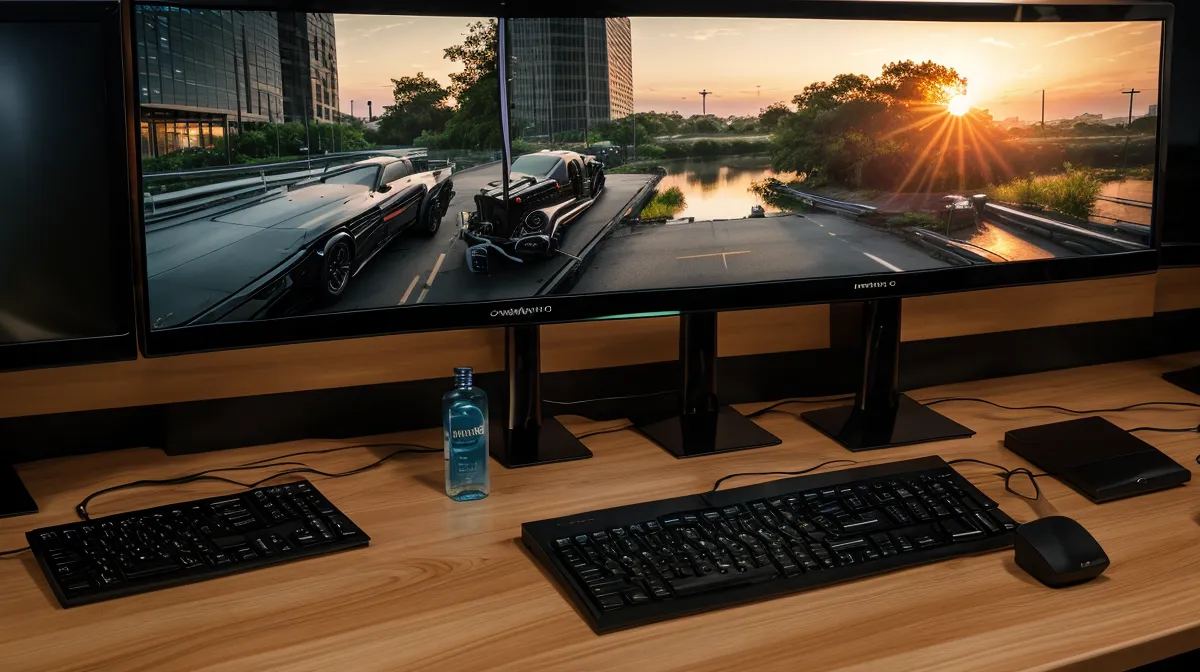
My wife asked when I'd gotten new glasses one evening, even though I hadn't. That question got stuck in my head, and it's the reason this post exists at all. I'm a freelance web developer who stares at three monitors for a living, and after fourteen months of tracking digital eye strain and running my own supplement-testing experiment, my spreadsheet finally gives me a defensible answer about what actually worked — and what was just expensive guesswork wearing a label.
Quick disclosure before we go further: this post contains affiliate links, and if you buy through them I earn a small commission at no extra cost to you. Nothing here comes from a medical license I don't have — I'm not an optometrist, just a developer who got tired of losing afternoons to blurry text and happens to track everything compulsively. Talk to an actual eye doctor before you change your own routine.
My wife caught me rubbing my eyes at the kitchen table one evening and asked, offhand, when I'd gotten new glasses. I hadn't. Same frames, same prescription, same everything I'd been wearing for a couple of years — the only thing that had actually changed was how hard my eyes were working to get through a normal workday. That's a strange kind of evidence: your own face advertising a problem you'd already been tracking privately in a spreadsheet for months.
Ever since I went fully remote, my eyes have taken the brunt of the job in a way my back and wrists never did. Three monitors, long sessions, and headaches that showed up like clockwork around 3pm — my optometrist had a name for it (digital eye strain), but no single fix to hand me. That diagnosis sent me down a rabbit hole that's basically become my own developer-wellness side project, and the wife-and-glasses moment is what finally pushed me to write all of it down instead of just keeping it in my head.
Why Didn't Blue Light Glasses Fix My Digital Eye Strain?
When my optometrist first used the phrase, I did what any developer does with a bug report: I tried to patch it with hardware. I bought a decent pair of blue light glasses, played with my monitor refresh rates, and set the 20-20-20 rule as a recurring reminder — look at something 20 feet away for 20 seconds every 20 minutes. I even cranked f.lux all the way to its warmest amber setting and just left it there the whole day, figuring one blanket fix beat fiddling with settings constantly. None of it held up once I was deep in a real deploy. You can't pause a production incident to go stare at a tree.
Somewhere in there I realized the actual problem wasn't input, it was processing. My eyes were a system with too much latency and not enough recovery time between frames, and no amount of external hardware was going to fix that from the outside. That's what pushed me toward supplements instead of another pair of glasses or another monitor setting — my own crash course in screen-eye-care, if you want to put a label on it.
The Problem With 'Just Take a Break'
Most general health advice says to take more breaks, which is true and also useless for anyone mid-sprint on a deadline. Competitive gamers don't get to look away for twenty seconds during a ranked match, and freelance developers racing a client deadline aren't that different — the eyes have to keep performing under sustained load, not just survive it. I needed something built for that kind of use, not for someone who checks email for twenty minutes a day. That's roughly when I started paying attention to supplements formulated around the macula of the retina rather than generic "eye health" marketing copy.
I'll admit the irony isn't lost on me: a guy who built his whole career on staring at screens, now trying to reverse-engineer a fix for the damage those same screens caused. It's the kind of problem you create by being good at your job.
TheyaVue: My Entry-Level Budget Test
Early on, I tested TheyaVue as my entry point into all of this — the budget pick, basically. The pitch is a wide, 24-ingredient formula, which reads more like a shotgun approach to eye support than anything narrowly targeted. If you're just starting to notice blur creeping in after a few hours at a screen, it's a reasonable place to run your own first experiment.
After a few months of logging, a pattern showed up that I didn't love: my eyes felt a little less gritty by evening, but the deeper, behind-the-socket ache barely moved. It reminded me of upgrading the RAM on a machine that still runs a spinning hard drive — technically better, not actually fast. Pricing is something you'd need to check directly on their own site since it shifts, but as a low-commitment way to see how your eyes respond to supplementation at all, it did its job.
iGenics and the Six-Week Wait
Next I moved to iGenics, which takes the opposite approach — a tighter list of 12 vision-supporting ingredients instead of a wide net. It's a well-known name with a strong reputation among people who track this stuff obsessively, like I apparently do now. The capsules are noticeably larger, which bothered a couple of people I mentioned it to, though at this point I'll swallow almost anything if the logs say it's working.
My notes show it took about six weeks before the 3pm fog started lifting at all, which is a long runway if you're hoping for a quick fix. It landed better than the budget option, but something was still missing — like I'd optimized the front end while the database queries stayed slow underneath. Late-night freelance sessions still wore me down by the end of them.
VisiFlora Changed My Afternoon Logs
The idea that gut health and eye health might be connected sounded like an edge case I'd normally ignore, until I mentioned it to Luciana Ferber over coffee at BookPeople on North Lamar one afternoon. Luciana and I worked together on a contract project years back, and she's one of the few people who'll call out my tracking habit for what it sometimes becomes — less curiosity, she said, more anxiety wearing a lab coat. She wasn't wrong, but she also didn't talk me out of trying VisiFlora, which is what actually moved the needle.
What I liked immediately, from a pure systems-design perspective, was the simplicity: one capsule a day, no stacking, no schedule to maintain. It's built around that gut-eye angle instead of piling on more of the usual ingredients, and for whatever reason, that was the exact piece my setup needed. For the first time in over a year of logging, my fatigue scores stopped spiking at 3pm — I was finishing a workday with roughly the same clarity I'd started it with.
Their money-back window runs 60 days, which gave me enough runway to treat it like a real sprint instead of a rushed trial. Current pricing is best checked on their own site since offers shift, but measured purely in afternoons I didn't lose to a headache, the return has been significant.
Measuring 'Better' Instead of Guessing
None of this would mean much without a way to actually measure it, so I built a dumb little 1-to-10 system: one score for "visual debt" (how much my eyes hurt) and another for how fast I could refocus moving between my three monitors. The full method, flaws included, is written up separately in my tracking notes and testing system, if you want the gory details instead of the summary.
Lutein and Zeaxanthin show up in nearly every formula I tried, and they're clearly a baseline rather than a differentiator — what actually separated the winners from the duds was how each supplement was delivered and absorbed, not which ingredient list looked more impressive on the label. Most of the options that failed for me weren't bad supplements exactly; they just weren't built for someone running a high-frequency, low-recovery workload like mine.
My old college friend Dex Harrington texted me a few weeks ago asking for the spreadsheet after his own eyes started acting up on a fully remote product-management job. He's the only person in my circle who actually told his eye doctor he was considering supplements before trying any of them — everyone else, myself included, just started popping capsules first and mentioned it to a professional later, if at all. I sent him my notes with the same caveat I'll give you: track your own numbers, and run anything new past someone with an actual license.
The 3pm Fog Is Gone
Comparing last winter's notes to this month's, the gap is obvious. I still log ten-hour days across the same three monitors — the irony of wrecking my eyes to pay rent hasn't stopped being funny to me — but most of the physical toll that used to come with it is gone. Standing up from the desk after a long stretch, the motor on my sit-stand setup still sticks a little before it finally engages, which is about the only sluggish thing left in my whole routine.
If you're stuck in that same mid-afternoon fog, don't just reach for more hardware — glasses, lighting, refresh rates, all of it treats the symptom, not the cause I eventually tracked down. If you want the longer breakdown of how these three stacked up against each other, I wrote a full comparison of VisiFlora vs TheyaVue that goes deeper than this post has room for.

Across fourteen months and three real contenders, VisiFlora is the one that actually held up under a developer's workload — not because it's magic, but because the delivery method matched what my particular system needed. The real takeaway, if you only remember one thing from this whole experiment, is to track your own numbers before you believe anyone's marketing, including mine: talk to your optometrist, change one variable at a time, and give it long enough to show up in your own logs before you call it a win or a loss.